Free US Shipping Orders $100+

What Is a Chef Skillet?

A chef skillet is a frying pan with curved, sloping walls that rise smoothly from the cooking surface to the rim. Unlike traditional skillets with straight vertical sides, the chef skillet's curved profile creates a continuous ramp from base to edge—making it easier to flip, toss, and slide food out of the pan.

The design originated in professional kitchens where cooks needed to move food quickly and efficiently. Today, chef skillets remain the preferred pan for eggs, sautéed vegetables, stir-fries, and any dish that benefits from active movement during cooking.

Chef Skillet vs Traditional Skillet: Key Differences

Feature Chef Skillet Traditional Skillet
Wall angle Curved/sloped (typically 25-35 degrees) Straight/vertical
Food movement Easy tossing and flipping Food typically stays in place
Best for Eggs, sautéing, stir-fry Searing, frying, baking
Liquid retention Lower sides = less capacity Higher sides = more capacity
Spatula access Unrestricted from any angle Limited by vertical walls

The fundamental difference is wall geometry. A traditional skillet's straight walls create a defined boundary that keeps food contained—ideal for dishes with liquids or when you want ingredients to stay put while developing a crust. A chef skillet's curved walls sacrifice some depth for dramatically improved maneuverability.

Why Professional Cooks Choose Curved Walls

The curved wall of a chef skillet acts as a ramp. When you push the pan forward and pull back sharply, food travels up the curved surface and flips in the air. This technique—called tossing or sautéing (from the French sauter, meaning to jump)—allows cooks to:

    • Redistribute heat evenly by constantly moving food across the cooking surface
    • Cook faster by exposing all sides of ingredients to high heat
    • Avoid crushing delicate foods like eggs or fish that would break apart with a spatula
    • Build fond efficiently by keeping food in motion without scraping

The physics are straightforward: curved walls provide a smooth, continuous surface for food to travel along. Straight walls create a sharp angle where food catches and tumbles unpredictably.

The curved walls of a No.5 Chef Skillet

A Note on Vintage Cast Iron Chef Skillets

Cast iron chef skillets were relatively rare during the golden age of American cast iron manufacturing. While foundries like Griswold and Wagner produced countless traditional skillets from the 1860s through the 1950s, the chef skillet with its sloped walls was a specialty item—not a mainline product.

Wagner was the primary American manufacturer of cast iron chef skillets, introducing their model 1386 (a 9-inch chef skillet) around 1935. These pans featured the same smooth, polished surface as their traditional skillets, but with the curved walls professional cooks preferred for eggs and sautéing. At just under 3 pounds, the Wagner 1386 was light enough for comfortable tossing.

Griswold, despite being the other major name in vintage cast iron, didn't produce a dedicated chef skillet during their classic era. The "Griswold Chef Skillet" you might encounter was actually made in the Wagner foundry after the two companies merged in 1957.

If you're hunting for a vintage cast iron chef skillet, Wagner's 1386 is the one to look for. They're described by collectors as "hard to find," but they do turn up on eBay and through the Wagner and Griswold Society. Expect to pay a premium for well-restored pieces. 

Vintage Wagner on Etsy

Best Uses for a Chef Skillet

Eggs

The chef skillet is the definitive pan for eggs. The curved walls allow you to swirl, fold, and slide eggs, whether you're making them fried, scrambled, or a perfectly folded omelet.

Many home cooks struggle with eggs sticking in straight-sided pans because the spatula can't reach the curved junction where the base meets the wall. In a chef skillet, there is no corner—just a smooth curve that releases eggs effortlessly.

Sautéed Vegetables

Vegetables cut into uniform pieces cook best with constant movement. The chef skillet lets you toss a pan full of onions, mushrooms, or peppers without chasing them around with a spatula. The sloped walls also make it easy to push finished vegetables up the side while you add more ingredients to the hot center.

Stir-Fry

While a traditional wok remains the ideal stir-fry vessel, a cast iron chef skillet makes an excellent substitute. The curved walls provide a similar tossing motion, and cast iron's heat retention ensures ingredients sear rather than steam—even on a home burner that can't match a restaurant wok station's BTUs.

Pan Sauces

The curved walls make it easy to swirl deglazing liquid across the entire surface, picking up fond efficiently. And when it's time to plate, the sloped sides guide sauce smoothly out of the pan. It's also a great pan for melting better. 

What a Chef Skillet Is NOT Best For

    • Deep frying: The low, sloped sides don't contain enough oil safely
    • Braises or stews: Insufficient depth for liquid-based cooking (use a Dutch oven instead)
    • Some styles of baking: While cornbread works great, more delicate bakes like pies benefit from straight-sided skillets that maintain their shape
    • Heavy searing where you don't want movement: Sometimes you want food to stay put

A Note on Terminology

Cookware naming can be confusing, especially when French culinary terms meet American marketing. Here's a quick guide:

Chef Skillet / French Skillet / Omelette Pan

These terms all describe the same thing: a pan with curved, sloping walls designed for tossing and flipping. The French call this a sauteuse (from sauter, "to jump"). It's the pan of choice for eggs, quick sautés, and any dish where you want to move food actively.

Sauté Pan / Sautoir

Despite the similar name, a sauté pan is a different tool entirely. It has straight, vertical sides, a wide flat bottom, and typically comes with a lid. The French call this a sautoir. The straight walls contain liquids better, making it ideal for braising, making pan sauces, or any dish where you don't want spillage. You can sauté in a sauté pan, but you can't really toss food in one.

Skillet / Frying Pan

These general terms can refer to either style, depending on the manufacturer. When shopping, look at the wall angle rather than the name. Curved walls = chef skillet. Straight walls = traditional skillet or sauté pan.

Why It Matters

Understanding these distinctions helps you choose the right tool. A chef skillet and sauté pan are complementary, not interchangeable. The chef skillet excels at quick, active cooking where you're moving food constantly. The sauté pan excels at contained cooking where liquid is involved. 

Chef Skillet Sizing Guide

Chef skillets typically come in two practical sizes for home cooking:

Small Chef Skillet (7-8 inches)

The small chef skillet is purpose-built for eggs. Its compact size heats quickly and evenly, and the lighter weight makes one-handed tossing natural. This size comfortably handles:

    • 2-3 egg omelets
    • Single portions of scrambled eggs
    • Small batches of sautéed mushrooms or other quick-cooking vegetables
    • Individual portion pan sauces

A 7-8 inch chef skillet is light enough to use with a wrist-flick motion that larger pans can't match. For dedicated egg cooking, this size is essential. The No.5 Chef Skillet at 7.5 inches and 2.2 lbs is designed exactly for this purpose.

Standard Chef Skillet (9-10 inches)

The standard chef skillet handles everyday sautéing for 2-4 people. This is the workhorse size for:

    • Sautéed vegetables as a side dish
    • Stir-fries for two
    • Pan sauces after searing
    • Larger omelets (4-6 eggs)

A 9-10 inch cast iron chef skillet weighs more than its smaller sibling, so tossing requires more arm engagement than wrist action. Most cooks find this size balances capacity and maneuverability well.

Frequently Asked Questions

Is a chef skillet the same as a frying pan?

A chef skillet is a type of frying pan distinguished by its curved, sloping walls. All chef skillets are frying pans, but not all frying pans are chef skillets. Traditional frying pans typically have straighter, more vertical sides.

Can I use a chef skillet for everything?

A chef skillet excels at eggs, sautéing, and any dish where you're actively moving food during cooking. For deep frying, braising, baking, or heavy searing where you want food to stay stationary, a traditional skillet with straight sides works better.

Why are curved walls better for eggs?

Curved walls eliminate the corner where eggs typically stick and provide a smooth ramp for sliding eggs out of the pan. The geometry also allows you to swirl eggs into the center without using a spatula, which is key for creamy, curd-free scrambled eggs.

What material is best for a chef skillet? 

The two most common choices are synthetic nonstick and carbon steel—and both have real merit. Carbon steel is utilitarian lightweight, heats quickly, and is a staple in professional kitchens. Synthetic nonstick is what most home cooks default to for eggs. Convenient (until it isn't). Those coatings degrade, and what comes off them isn't something you want in your food. Ceramic alternatives recently have promise a cleaner option, but their true safety still isn't clear and they lose their slick surface within a year or two. 

Cast iron is the option we picked. It builds seasoning better than carbon steel for long-term nonstick performance. It holds heat longer, cooks more evenly, and is essentially indestructible. The catch has always been weight. The No.5 Chef Skillet was built to close that gap. Pure iron, no coatings, nothing that wears out — and at 2.2 lbs, light enough to flip one-handed.

The choice comes down to personal preference and cooking style. At Field, we love the beauty, simplicity, and longevity of cast iron.

Do chef skillets work on induction?

Yes—all cast iron skillets, including chef skillets, work on induction. Cast iron is naturally magnetic, which is exactly what induction cooktops require (even if the bottom of the pan doesn't have full contact).

How do I season a cast iron chef skillet?

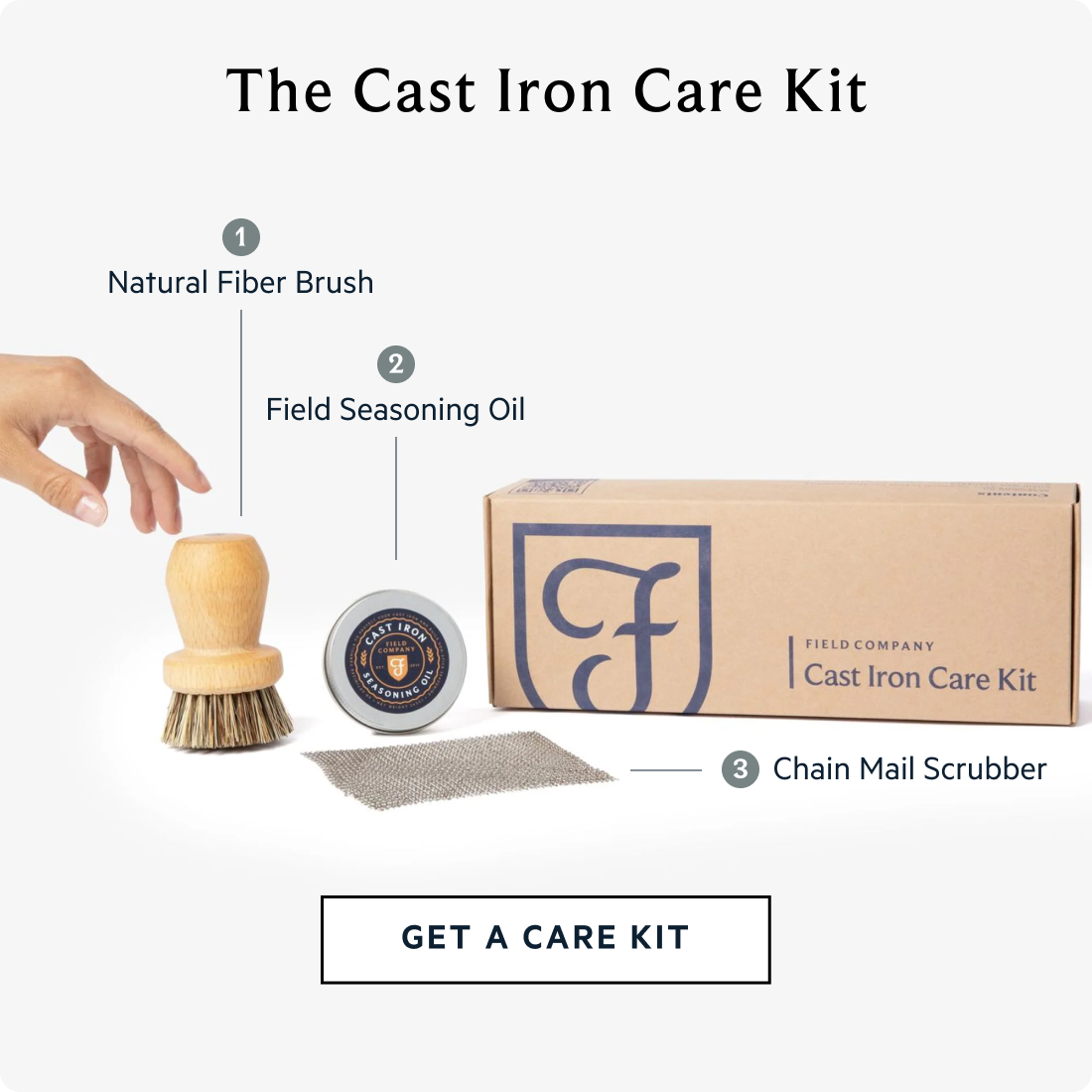
Season a chef skillet the same way you'd season any cast iron. Our preferred method is a natural seasoning process while cooking that we call The Field Method. After cleaning your pan, apply a thin layer of oil (like our Cast Iron Seasoning Oil), and then just keep cooking. Next time you heat up your pan that layer will start to polymerize (along with your cooking oil) to form a new seasoning layer. 

Can I put a cast iron chef skillet in the oven?

Yes. Cast iron is oven-safe at any temperature your oven can reach. This makes chef skillets excellent for dishes that start on the stovetop and finish in the oven, like frittatas or baked eggs.
Further Reading

For those who want to dig deeper into the world of chef skillets, sautéing technique, and vintage cast iron: